Traditional Cigarettes vs E-cigarettes vs Heated Tobacco Products vs Snuff: Differential Effects on the Nasal Cavity and Lungs
The mode of use of nicotine and tobacco-related products determines the initial contact site, deposition level, and absorption pathway of irritants entering the human body. While all involve "nicotine intake," oral inhalation of combustion smoke, oral inhalation of aerosolized vapor, oral inhalation of heated tobacco aerosol, and nasal inhalation of dry snuff powder produce different pathways of harm to the nasal mucosa and lung parenchyma. This article systematically compares traditional cigarettes, e-cigarettes, heated tobacco products (HNB/HTP), and snuff (primarily dry/nasal snuff) across three dimensions — irritant type, deposition site, and absorption route — and strives to present information objectively based on available scientific evidence, while clearly indicating evidence boundaries and uncertainties.
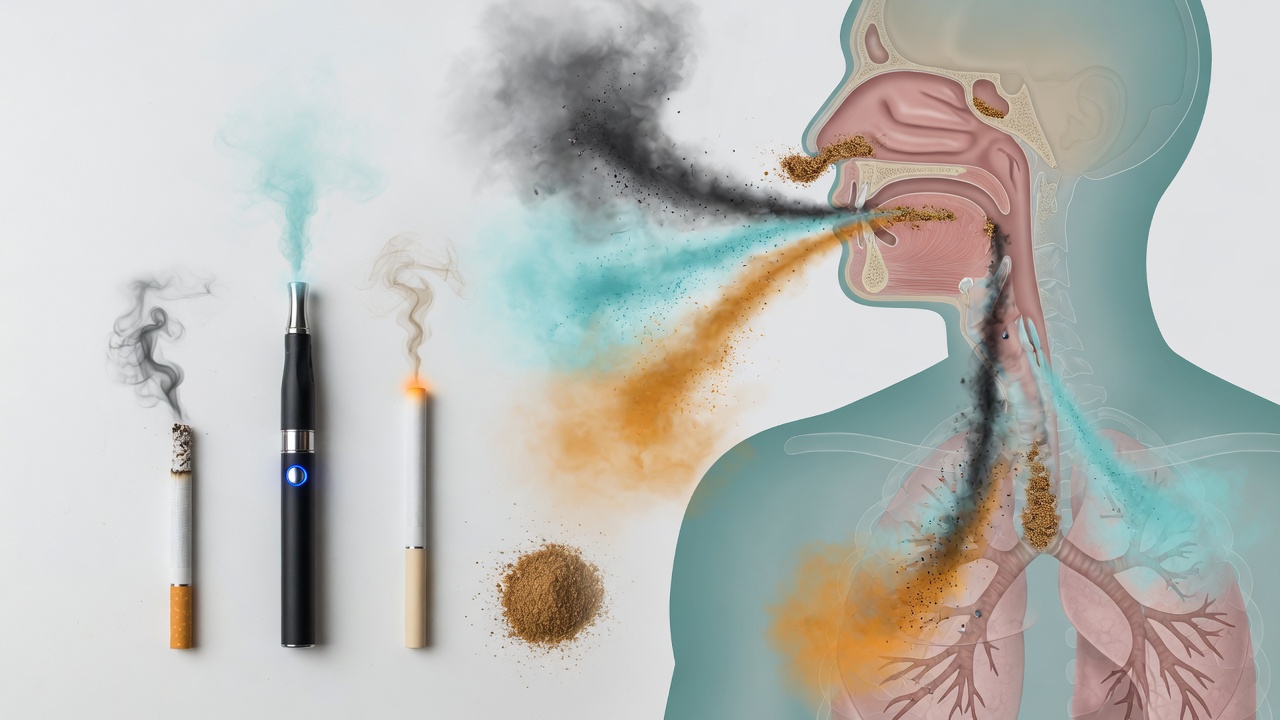
Key Parameters
I. Basic Definitions and Exposure Forms of the Four Product Types
| Product | Core Principle | Primary Exposure Form | Primary Route of Use |
|---|---|---|---|
| Traditional cigarettes | High-temperature combustion of tobacco (approx. 700-900°C) | Smoke: gaseous substances + particulate phase (tar, carbonaceous particles, etc.) | Oral inhalation → entire respiratory tract → alveoli |
| E-cigarettes | Heating e-liquid to aerosolize (typically approx. 200-350°C, device-dependent) | Aerosol: liquid droplets/ultrafine particles + volatile organic compounds | Oral inhalation → respiratory tract → lungs |
| Heated tobacco products | Heating tobacco (approx. 250-350°C), without full combustion | Tobacco-containing aerosol | Oral inhalation → respiratory tract → lungs |
| Snuff (dry snuff) | Ground tobacco powder inhaled/snuffed through the nose | Solid micropowder + soluble/extractable chemicals | Primarily remains in the nasal cavity-nasopharynx, generally not drawn into the lower respiratory tract as in "smoke-like deep inhalation" |
Important distinction: Commercial "snuff" is often confused — moist snuff/dip (and some snus products) are placed between the lip and gum for buccal mucosal absorption; dry snuff is the traditional nasal form. In this article, "snuff effects on the nasal cavity" primarily refers to nasal dry snuff; oral tobacco products have a weaker direct nasal impact but still produce significant oral mucosal and systemic nicotine exposure.
II. Types of Irritants: What You Are Inhaling
1. Traditional Cigarettes
Combustion produces thousands of chemical substances. Those highly relevant to respiratory tract damage include:
- Particulate phase: Tar-related compounds, carbonaceous/semi-volatile particles, particle size often concentrated in the submicron range (many studies show a significant mass fraction in the 0.4-1.3 μm range), readily reaching the bronchi and alveolar regions.
- Gaseous/semi-volatile: Carbon monoxide, volatile organic compounds, carbonyl compounds (formaldehyde, acetaldehyde, acrolein, etc.), nitrogen oxides, etc.
- Tobacco-specific nitrosamines (TSNAs), polycyclic aromatic hydrocarbons (PAHs), aromatic amines, heavy metals and other known or potential carcinogenic/pro-inflammatory components.
- Nicotine exists in free base and protonated forms in smoke, rapidly absorbed into the bloodstream through the lungs.
Role of the nasal cavity: When mainstream smoke is inhaled orally, the nasal cavity is not the primary pathway, but sidestream smoke/environmental tobacco smoke can cause nasal irritation; exhaled smoke from active smokers and ambient exposure also affect the nasal mucosa.
2. E-cigarettes
No tobacco combustion occurs, tar and carbon monoxide are significantly lower than in cigarettes, but they are not "just water vapor":
- Carrier solvents: Propylene glycol (PG), vegetable glycerin (VG) — hygroscopic, can irritate the airways, some users experience dry throat and irritant cough.
- Nicotine (concentration can be very high, especially in some cartridges/open systems).
- Flavor pyrolysis/reaction products: Various flavoring chemicals; heating can generate carbonyl compounds (formaldehyde, acetaldehyde, etc.).
- Metal traces: Nickel, chromium, lead from heating coils/solder joints, entering the respiratory tract with the aerosol.
- Particle characteristics: The aerosol consists mainly of ultrafine/submicron droplets, capable of penetrating deep into the lower respiratory tract; particle size is closely related to power, e-liquid ratio, and puffing behavior.
Acute lung injury background: The EVALI (E-cigarette or Vaping product use-Associated Lung Injury) outbreak was strongly associated with illicit additives (particularly vitamin E acetate in THC-containing products) and cannot be simply extrapolated to all regulated nicotine e-cigarettes. However, it demonstrates that inhalation of unknown oil-soluble additives can cause severe alveolar damage.
3. Heated Tobacco Products (HNB/HTP)
The raw material is still tobacco, heated to produce a nicotine-containing aerosol:
- Multiple HPHCs (Harmful and Potentially Harmful Constituents) are often at lower levels than combustible cigarettes, but significantly higher than clean air, and these products are not equivalent to being "non-toxic."
- TSNAs, carbonyls, VOCs, etc. remain detectable; some studies indicate that under insufficiently disclosed or specific conditions, certain components may be comparable to or even higher than cigarettes — demonstrating product and test condition dependence.
- Aerosol particles are mostly <1 μm, meeting the physical conditions for deep lung deposition.
- Nicotine delivery can approach cigarette levels; addictiveness cannot be simply regarded as reduced.
4. Snuff (Nasal Dry Snuff)
- Solid tobacco microparticles directly contact the nasal mucosa.
- Nicotine is absorbed into the blood through the nasal mucosa; swallowing saliva/nasal secretions also leads to partial gastrointestinal absorption.
- Contains TSNAs and other compounds from tobacco, with locally high-concentration contact with the nasal-nasopharyngeal epithelium.
- Typically no combustion smoke, therefore lung exposure to tar, CO, and combustion particles is far lower than smoking — this is the main physicochemical basis for the difference in lung cancer risk between snuff and cigarettes.
- However, "low lung cancer-related exposure" does not equal safety: local chronic inflammation of the nasal cavity, mucosal structural changes, and systemic nicotine and cardiovascular risks remain.
III. Deposition Sites: At Which Respiratory Level Does the Harm Occur?
Respiratory tract deposition follows the principles of particle size, hygroscopic growth, airflow, and breathing patterns (inertial impaction, sedimentation, diffusion):
Traditional Cigarettes
- Deposition can occur in the oropharynx, larynx, tracheobronchial tree, and alveoli.
- Submicron particles and soluble gas-phase components can reach distal airways and alveoli, which is the key pathway for lower respiratory tract outcomes such as COPD, emphysema, and lung cancer.
- The nasal cavity is not the primary deposition area during active oral smoking, but secondhand smoke and mixed breathing patterns can still affect the nasal mucosa (reports of chronic rhinitis, impaired mucociliary clearance, etc.).
E-cigarettes
- When the aerosol is deeply inhaled orally, the deposition pattern is highly correlated with power, PG/VG ratio, puff volume, and breath hold.
- Droplets can hygroscopically grow within the airways, altering deposition distribution; ultrafine components can still penetrate deep into the lungs.
- The upper respiratory tract (oropharynx, larynx, proximal bronchi) commonly experiences irritation and dryness; inflammation and airway hyperresponsiveness have been reported in the lower respiratory tract.
- For the nasal cavity: during active use, the primary route is oral; nasal irritation mostly comes from exhaled aerosol, environmental aerosol, or oronasal breathing — generally weaker than the direct impact of dry nasal powder.
Heated Tobacco Products
- Similar to e-cigarettes, primarily oral inhalation of aerosol, with target organs being the lower respiratory tract and systemic circulation.
- Particles are mostly submicron, meeting conditions for deep lung deposition.
- Tobacco matrix components place the chemical profile between cigarette smoke and e-liquid aerosol.
- Nasal exposure is similarly mostly indirect/environmental, not the primary target of product design.
Snuff (Nasal)
- Primary and high-concentration deposition sites: nasal vestibule, turbinates, septal mucosa, nasopharynx.
- Associated in literature and clinical observations with: chronic rhinitis-like changes, nasal congestion, rhinorrhea, turbinate mucosal edema, tendency toward middle and inferior turbinate atrophy, mucociliary clearance inhibition, etc.
- Direct lung particle burden is significantly lower than smoking: this is one of the core differences in the lung cancer risk narrative regarding "smokeless tobacco vs. smoking."
- If the user forcefully deep-inhales the powder, a small number of particles could theoretically enter deeper airways, but the mainstream harm narrative remains focused on the nasal-pharyngeal region and systemic nicotine/carcinogen absorption, rather than the typical "smoking-related lung disease pathway."
Summary comparison:
- Cigarettes / E-cigarettes / HNB: The lungs are a primary battlefield (differing in degree and chemical profile).
- Nasal snuff: The nasal mucosa is the primary battlefield; combustion-related lung damage pathways are weak, but it is not systemically harmless.
IV. Absorption Routes: How Nicotine and Toxicants Enter the Bloodstream
| Route | Primary Absorption Interface | Onset and Pharmacokinetic Characteristics (Summary) | Implications for Local Tissue |
|---|---|---|---|
| Traditional cigarettes | Large alveolar surface area | Very rapid nicotine absorption, high peak level, reinforcing addiction | Lung epithelium simultaneously bears particulate and gas-phase toxicants |
| E-cigarettes | Respiratory mucosa + alveoli (depending on inhalation method) | Can approach cigarette-like nicotine delivery (device-dependent) | Chronic irritation of airway epithelium by solvents, flavors, and metals |
| Heated tobacco products | Respiratory mucosa + alveoli | Nicotine delivery can approach cigarette levels | Continuous exposure of the lower respiratory tract to tobacco aerosol |
| Nasal snuff | **Nasal mucosa** (rich vasculature) + partial GI absorption after swallowing | Can achieve blood nicotine levels comparable to smoking; some studies suggest nicotine may persist longer in smokeless tobacco users | Prolonged high-concentration contact with nasal mucosa → structural and functional changes |
| Moist snuff/oral | Oral mucosa | Systemic nicotine exposure well-documented | Primarily oral/gingival, nasal secondary |
Common systemic effects: Regardless of route, nicotine increases heart rate, alters blood pressure, and affects vascular and endothelial function, while maintaining high addictiveness. Differences primarily lie in the local target organ toxicity profile and combustion product exposure.
V. Differential Pathways of Harm to the Nasal Mucosa
Traditional Cigarettes
- Mechanisms: Combustion product-induced oxidative stress, inflammation; mucus secretion and ciliary dysfunction; altered susceptibility to allergies and infections.
- Evidence characteristics: Substantial evidence links smoking to chronic rhinosinusitis symptoms, reduced olfaction, and mucosal pathological changes, but the "primary harms" of active smoking are still mainly attributed to the lower respiratory tract, cardiovascular system, and cancer.
- Pathway keywords: indirect nasal exposure + systemic inflammation/immune changes.
E-cigarettes
- Mechanisms: Aerosol irritation, drying effect (PG/VG), cytotoxicity of flavors and carbonyls; nasal irritation, rhinorrhea, or allergic-like reactions in some users.
- Evidence characteristics: Long-term human data on nasal histology are still less abundant than oral and pulmonary function indicators; subjective reports of upper respiratory irritation are more common.
- Pathway keywords: primarily upper respiratory irritation, the nose is not the sole target.
Heated Tobacco Products
- Mechanisms: Related to aerosol irritation, residual HPHCs, and thermal-chemical irritation; nasal data are relatively limited.
- Evidence characteristics: Most harm assessments focus on the lungs, cardiovascular system, and biomarkers; dedicated nasal mucosa studies are insufficient.
- Pathway keywords: significant evidence gap; cannot be extrapolated as "harmless to the nose."
Snuff (Nasal)
- Mechanisms:
- Mechanical-chemical direct irritation (dust + tobacco alkaloids and other components);
- Chronic inflammation and mucosal remodeling;
- Mucociliary clearance inhibition → reduced defense;
- Prolonged local contact with TSNAs, etc. → theoretically increased attention to upper respiratory tract tumor risk (nasal/sinus/nasopharyngeal risks discussed in smokeless tobacco and regional epidemiology, noting product type and regional confounders).
- Evidence characteristics: Studies show long-term heavy use can cause chronic rhinitis-like symptoms, nasal congestion, and turbinate morphological/functional changes; overall high-quality large-scale prospective data are still limited.
- Pathway keywords: Direct nasal mucosal toxicity pathway is the most clearly established.
VI. Differential Pathways of Harm to the Lungs
Traditional Cigarettes — The Most Thoroughly Documented Template for Lung Injury
- Chronic inflammation and airway remodeling → COPD, chronic bronchitis.
- Alveolar destruction → emphysema.
- Carcinogen deposition and DNA damage → significantly increased lung cancer risk (consensus-level).
- Carbon monoxide and particles → impaired gas exchange and synergistic cardiovascular damage.
- Pathway: Full-spectrum combustion toxicants × deep lung deposition × long-term accumulation.
E-cigarettes — Reducing Some Combustion Toxicants, Introducing a New Exposure Profile
- Compared to cigarettes: Multiple comparative studies show reduced concentrations of many toxic substances; however, this does not equal safety, as long-term hard endpoint data such as lung cancer are still immature (products have been on the market for a short time).
- Airways and lungs: Irritation, altered inflammatory markers, and adverse signals in pulmonary function indicators have appeared in some studies; flavor- and solvent-related cytotoxicity is supported by in vitro and animal studies.
- EVALI: Demonstrates that specific additives can cause severe alveolar damage and respiratory failure.
- Pathway: Ultrafine aerosol deep deposition + solvents/flavors/metals/carbonyls; lacking the typical tar pathway, but introducing new chemical pathways.
Heated Tobacco Products — Harm Reduction Narrative Coexists with Evidence Tension
- Compared to cigarettes: Multiple HPHC exposures are often reduced; regulatory agencies have issued limited statements that "completely switching can reduce exposure to harmful chemicals" for specific products (this is not equivalent to a comprehensive claim of being healthier, nor does it encourage never-users to start).
- Still contains tobacco aerosol and nicotine, and secondhand aerosol is also not clean air.
- Pathway: Submicron tobacco aerosol lung deposition + residual/specific chemicals; long-term pulmonary disease and tumor endpoint evidence remains insufficient, and the proportion of industry-funded studies requires careful interpretation.
Snuff (Nasal) — Weak Lung Combustion Pathway, Systemic and Local Pathways Remain
- Lung cancer: Due to the lack of typical deep lung exposure to combustion smoke, lung cancer risk is generally lower than that of continued smoking — this is the most frequently emphasized difference of smokeless tobacco relative to cigarettes and a key point in regulatory and public health discussions.
- However:
- Systemic nicotine and other absorbed components still affect the cardiovascular system;
- Irritation of deeper airways from forceful powder inhalation cannot be ruled out;
- Harm is transferred to the nasal cavity, oral cavity, and upper digestive tract, rather than eliminated.
- Pathway: Avoiding combustion-related lung exposure in exchange for high nasal mucosal exposure.
VII. Comprehensive Comparison Table (Nose vs. Lungs)
| Dimension | Traditional Cigarettes | E-cigarettes | Heated Tobacco Products | Nasal Snuff |
|---|---|---|---|---|
| Typical irritants | Full combustion spectrum: particles, CO, PAHs, TSNAs, carbonyls, etc. | PG/VG, nicotine, flavors, carbonyls, metals | Heated tobacco aerosol, nicotine, HPHCs | Tobacco microparticles, nicotine, TSNAs, etc. |
| Nasal mucosa primary pathway | Primarily secondhand/sidestream and indirect irritation | Irritation and environmental aerosol, moderate direct evidence | Limited data, possible indirect irritation | **Direct high-concentration deposition and chronic damage** |
| Lung primary pathway | **Deep deposition + combustion toxicants (strongest evidence)** | Ultrafine aerosol + new chemical profile | Submicron aerosol + residual HPHCs | **Low combustion-related lung exposure** |
| Absorption primary interface | Alveoli | Respiratory tract/alveoli | Respiratory tract/alveoli | **Nasal mucosa (± GI tract)** |
| Lung cancer consensus direction | Significantly increased | Uncertain/insufficient data, non-zero risk a reasonable assumption | Insufficient data; reduced exposure ≠ zero risk | Generally lower than smoking, not cancer-free risk |
| Common "harm reduction" statements | One of the highest baseline harms | Switching may reduce some exposures for current smokers | Some products have exposure modification authorized contexts | Lung-related risk often lower than smoking, nasal/oral risks prominent |
VIII. Common Mechanisms and Easily Confused Points
Common Mechanisms
- Nicotine addiction and systemic physiological effects span all products.
- Oxidative stress, inflammation, and epithelial barrier disruption are common themes in respiratory toxicology.
- "Reducing certain markers" does not equal "safety": dose-response, exposure duration, dual use, and product variation can all alter outcomes.
- Dual use (e.g., cigarettes + e-cigarettes) may offset any switching benefits.
Easily Confused Points
- "Smokeless" does not mean "harmless": snuff avoids smoke but intensifies nasal effects.
- "No tar" does not mean "no lung risk": e-cigarettes still have aerosol and additive issues.
- "Heated not burned" does not mean "produces no harmful substances": only the profile and quantity change.
- Similar particle size does not equal identical harm: chemical composition determines toxicity; cigarette and e-cigarette particle mass concentration ranges can overlap, but chemical profiles differ.
IX. Evidence Hierarchy and Limitations (Must Read)
- Traditional cigarettes: Most abundant human and mechanistic evidence.
- E-cigarettes and HNB: More data available on component analysis, biomarkers, and short-term clinical indicators; decade-scale tumor and COPD endpoints are still being accumulated; rapid product iteration means research often lags behind the market.
- Snuff: Nasal mucosal morphological and functional changes are supported by clinical studies and reviews; products from different regions (dry snuff, rapé, oral types) cannot be generalized; confounding factors (concurrent smoking, hygiene conditions, viral infections, etc.) affect tumor attribution.
- Industry-funded studies account for a relatively high proportion in the HNB field; interpretation requires independent verification and cross-checking with regulatory data.
- This article is a science communication-oriented systematic comparison and cannot replace medical diagnosis and treatment; individual symptoms (hemoptysis, progressive nasal obstruction, anosmia, dyspnea, etc.) require prompt medical attention.
X. Conclusion: Core Findings on Differential Effects
- Traditional cigarettes: Centered on deep lung deposition of combustion smoke; the nasal cavity can be affected, but the evidence chain for lung and systemic harm is the most complete and severe.
- E-cigarettes: Avoid the combustion tar pathway, but constitute a new exposure profile for the airways and lungs via solvents, flavors, and ultrafine aerosols; the nose is mostly a secondary target.
- Heated tobacco products: Still a tobacco aerosol lung deposition pathway; multiple harmful exposures are often lower than cigarettes, but it is not clean air; long-term endpoint evidence is insufficient.
- Nasal snuff: The harm pathway shifts upward and focuses on the nasal mucosa; combustion-related lung risk is generally lower than smoking, but at the cost of chronic nasal pathology and systemic nicotine exposure.
If the evaluation target is the nasal cavity, the local risk narrative for nasal snuff is the most prominent; if the target is the lungs, traditional cigarettes have the strongest evidence, e-cigarettes and HNB are secondary with different mechanisms, and nasal snuff is relatively lowest (but still carries other health costs). For any user, completely abstaining from tobacco and nicotine inhalation/snuff products remains the most clearly defined strategy for reducing nasal and lung-related risks; those already addicted should prioritize seeking evidence-based smoking cessation support, rather than engaging in the illusion of simple switching between different harm profiles.
Key References (for Verification)
- Aerosol particle size and deposition: studies on cigarette and e-cigarette particles predominantly distributed in the submicron range and capable of penetrating the lower respiratory tract (e.g., literature on particle size spectrum measurement and respiratory deposition modeling).
- E-cigarette and HNB components and EVALI: reports from public health agencies and clinical reviews on aerosol composition, carbonyls, metals, and e-cigarette-related lung injury.
- HNB and HPHCs: statements from the CDC and others on heated tobacco as "lower than cigarettes but still harmful, not clean air"; independent research providing cautious evaluation of industry harm reduction claims.
- Snuff and nasal mucosa: clinical observations and reviews on long-term snuff use and chronic rhinitis-like changes, turbinate and mucociliary function effects (e.g., studies on nasal mucosal effects of snuff).
- Systemic risks of smokeless tobacco: overviews from the American Cancer Society and others on nicotine absorption, addiction, and oral/local risks of smokeless tobacco.
(End)